
A timer cannot teach vocabulary, pronunciation, grammar, or conversation by itself. What it can do is give a language practice session a clear boundary, so you decide what to practise before opening another app or lesson.
This guide uses a 25-minute Pomodoro as a planning container. The useful part is the task inside the interval: recalling words without looking, listening for a specific feature, writing sentences, or speaking and reviewing a recording.
Twenty-five minutes is a starting point, not a proven optimum for every learner. Use a shorter interval if you are new, tired, or working with difficult material, and a longer one when a conversation or writing task needs continuity.
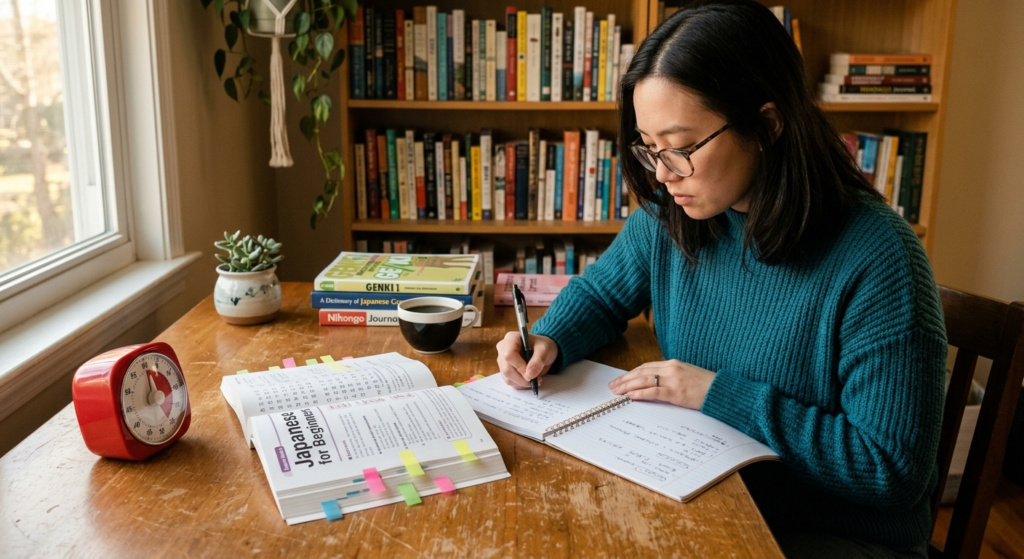
What a Language Pomodoro Should Accomplish
Give each session one observable outcome. “Study Spanish” is too broad. “Recall 20 travel words and write five original sentences” tells you exactly what completion looks like.
- Review a small set of previously learned material before adding new items.
- Produce an answer before checking the solution whenever the activity allows it.
- Record errors that need another attempt; do not turn the session into a perfect notebook.
- Finish with a one-line note describing what to practise next.
A Practical 25-Minute Session
Minutes 0–3: Set the target
Choose one skill and one source. Put unrelated tabs and notifications away. Write the finish line in plain language, such as “listen to the two-minute clip twice and transcribe the verbs.”
Minutes 3–13: Retrieve or notice
Work before looking at the answer. For vocabulary, cover the translation and recall it. For listening, predict or transcribe before reading captions. For grammar, complete examples before opening the key. Retrieval gives you useful information about what is available from memory.
Minutes 13–22: Use the material
Turn recognition into production. Say the words in new sentences, write a short reply, summarize the clip aloud, or answer a realistic prompt. Keep the output small enough to review before the timer ends.
Minutes 22–25: Check and leave a next step
Compare your work with a reliable reference or teacher feedback. Mark only errors that affect meaning or a pattern you are deliberately practising. Schedule the difficult items for another day and write the next action.
Choose One Skill per Session
Mixing several resources inside one short interval often creates more switching than practice. Assign different sessions to different skills instead.
- Vocabulary: recall a limited set, use each item in context, then separate known and uncertain items.
- Listening: use a short recording; listen once for meaning, again for detail, and then check a transcript if available.
- Pronunciation: copy a brief native-speaker sample, record yourself, and compare one feature such as stress or a specific sound.
- Reading: read a manageable passage, mark only words that block meaning, and summarize the main point without looking.
- Writing: answer one prompt, then revise for one target such as verb tense, agreement, or word order.
- Speaking: prepare for two minutes, speak for three to five minutes, listen back, and choose one correction for the next attempt.
A Seven-Day Example Plan
A repeatable plan can be more useful than trying to cover every skill every day. This example uses one session on weekdays and two optional review sessions at the weekend.
- Monday: recall last week’s vocabulary and use uncertain words in sentences.
- Tuesday: listen to a short clip and produce a brief spoken summary.
- Wednesday: write a response using the week’s grammar target.
- Thursday: practise pronunciation from a short, repeatable audio sample.
- Friday: hold a short conversation, answer recorded prompts, or speak from a topic card.
- Saturday: retest the items marked uncertain during the week.
- Sunday: review the log, choose next week’s material, or rest.
If you already attend a class, build the sessions around its syllabus. The timer should organize practice, not create a second curriculum.
How to Adapt the Interval
Use ten to fifteen minutes when starting feels difficult or when the material is dense. Use 25 minutes for a contained review or production task. Use a longer block for conversation, extensive reading, or an exam simulation, but add a check-in point so fatigue does not become automatic scrolling.
Do not stop in the middle of a sentence just to obey the alarm. Finish the thought, save the work, and record the actual stopping time. A timer is a boundary and reminder, not a test of obedience.
What to Do During the Break
A short break should create separation from the task. Stand up, drink water, or look away from the screen. If you open another feed or lesson, the break becomes another attention task.
The break is not where learning magically consolidates, and skipping one break does not erase the session. Its practical purpose is to pause, notice fatigue, and decide whether another focused round is sensible.
Measure Progress Without Guessing
Hours studied can be useful for planning, but they do not show what you can now understand or produce. Keep a small weekly record with measures tied to the skill.
- How many previously studied words could you recall before checking?
- Could you understand the clip without captions, and what details were missed?
- How many sentences could you write or speak using the target structure accurately?
- Which error appeared more than once?
- What can you do now that was difficult last week?
Retest a sample of older material rather than testing only what you studied today. If performance is not improving, change the task, feedback source, or difficulty instead of simply adding more timer rounds.
Pomodoro, Spacing, and What Research Actually Supports
The Pomodoro Technique is a time-management system created by Francesco Cirillo. Its official resources describe a broader process of planning, recording, and managing interruptions; it is not a scientific claim that 25 minutes is the ideal learning duration.
Language-learning research does support distributing practice across time in many contexts. For example, Bahrick and colleagues studied the long-term maintenance of foreign-language vocabulary under different relearning schedules. Read the 1993 study and DOI record. That evidence supports returning to material over time; it does not prove that one daily timer pattern works best for every language, learner, or skill.
Common Mistakes
- Using a vague task: decide what will be produced or checked before starting.
- Adding too much new material: leave room to retrieve and use older material.
- Counting sessions as mastery: test the language, not the number of completed timers.
- Changing resources every few minutes: keep one source for the interval unless comparison is the task.
- Ignoring feedback: use an answer key, transcript, teacher, language partner, or trusted reference appropriate to the activity.
- Forcing 25 minutes: adjust the duration when the task or accessibility need requires it.
Frequently Asked Questions
Is 25 minutes enough to learn a language?
No single session length is enough by itself. A 25-minute interval can hold one useful practice task, but progress depends on the quality of the activity, feedback, prior knowledge, and repeated practice over time.
Should I use a language app for the whole session?
Use an app when its exercise matches your target. Add speaking, writing, or recall outside the app when you need to practise producing the language rather than selecting an answer.
How many sessions should I do each day?
Start with one repeatable session. Add another only when you can maintain the quality of practice and review the errors. Consistency matters more than building a large daily count you cannot sustain.
Can I use this plan with a teacher or course?
Yes. Use the timer to practise course objectives and bring recurring errors to the teacher. The timer should support instruction, not replace it.
Start With One Verifiable Session
Choose one skill, define one outcome, and start the free Pomodoro timer. When it ends, record what you completed and the next item to revisit. That small log is more useful than claiming the timer made the learning happen.
Published by Relnov. This guide provides general study-planning information and does not promise a particular fluency or memory outcome. Send corrections or source suggestions to hello@relnov.com.