
I found the Pomodoro technique book completely by accident.
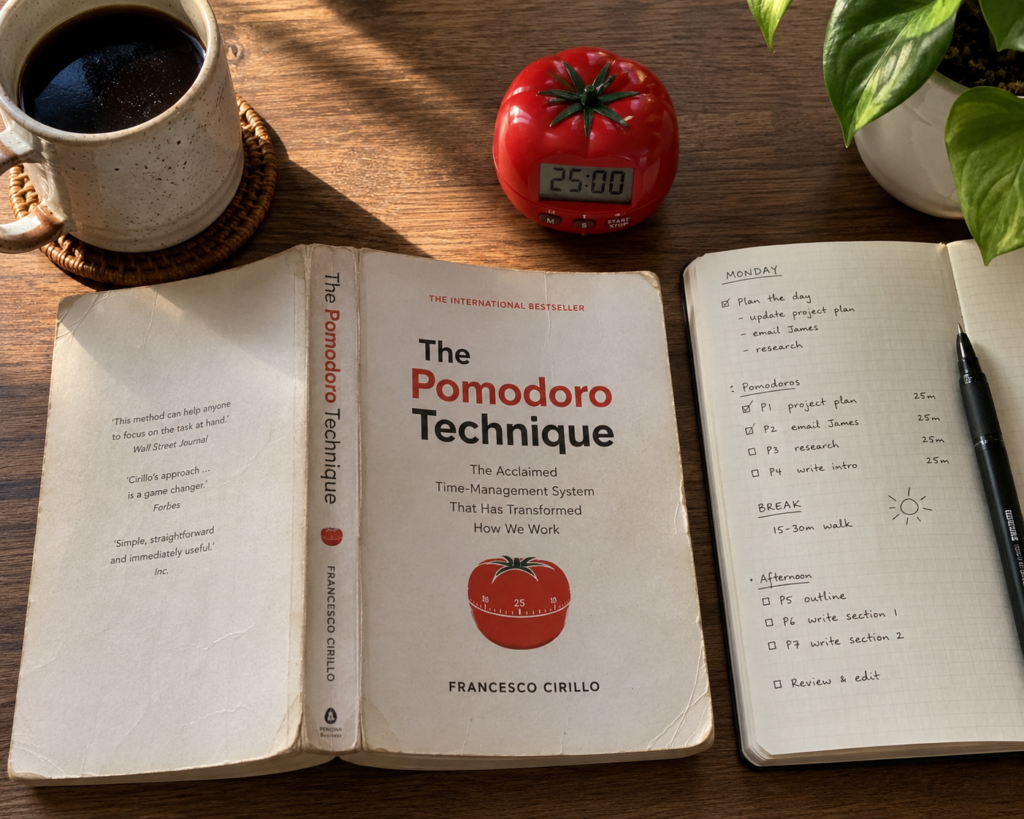
It was a Tuesday afternoon, exam week, and I was sitting in my university library surrounded by highlighters, half-empty coffee cups, and about four hours of “studying” that had produced almost nothing useful. A classmate walked past, glanced at my messy desk, and dropped a small paperback in front of me without saying a word. It was Francesco Cirillo’s original book on the Pomodoro method.
I picked it up mostly out of curiosity. By the time I finished reading it that evening, I had already set a timer and started my first real focused session in weeks.
That was three years ago. I still use the method every single day.
If you’ve heard about the Pomodoro technique — maybe through a productivity blog, a YouTube video, or a friend — but never actually looked at where it all started, this guide is for you. We’ll go deep on the original method, the book behind it, and everything you need to know to make it work for you.
What Is the Pomodoro Technique? The Idea Behind the Book
Before we get into the book itself, let’s answer the question that most people ask first.
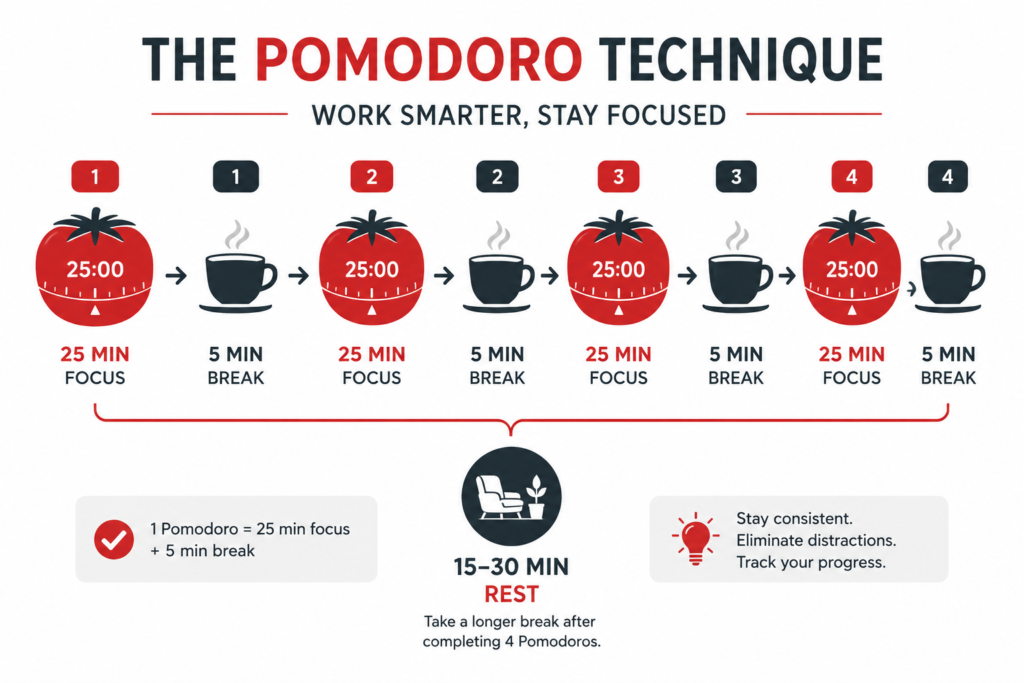
What is the Pomodoro technique? At its core, it is a time management strategy that breaks your work into focused 25-minute sessions separated by short breaks. Each session is called a Pomodoro. After four of them, you take a longer break and start again.
That’s the surface level answer. But the real idea behind the method runs a bit deeper than just setting a timer.
Francesco Cirillo’s central argument in the book is that most people don’t struggle with the amount of work they have. They struggle with how they relate to time. We treat time as an enemy, something that’s always running out and always working against us. The Pomodoro technique flips that relationship. The timer stops being a source of pressure and starts becoming a tool you control.
The Pomodoro technique is a time management strategy that works specifically because it removes the two biggest obstacles to real focus, which are the anxiety of an endless task and the distraction of an unstructured day. When you know exactly what you’re working on and exactly how long you’ll work on it, starting becomes dramatically easier.
Why Is It Called the Pomodoro Technique?
This is one of those questions that sounds trivial but actually tells you a lot about the philosophy behind the method.
Why is it called the Pomodoro technique? The answer is simpler than most people expect. Francesco Cirillo named it after a tomato-shaped kitchen timer he used as a university student in Rome in the late 1980s. Pomodoro is just the Italian word for tomato.
He wasn’t trying to be clever or create a brand. He was a struggling student who grabbed whatever timer was nearby and started experimenting with short, structured work sessions to pull himself out of a cycle of procrastination and overwhelm. The tomato timer happened to be sitting on his kitchen counter that day.
What started as a personal experiment became a method he refined over years of working with students and professionals. The book came later, but the name stuck from the very beginning because of that original tomato-shaped timer on his desk..
The Pomodoro Technique Book: What Francesco Cirillo Actually Wrote
The Pomodoro technique by Francesco Cirillo is a surprisingly short book. Most people expect something dense and academic. What they get instead is direct, practical, and written by someone who clearly developed this method through real use rather than theory.
The book is built around six core objectives. It teaches you how to find out how much effort a task actually requires, how to cut down on interruptions, and how to estimate the effort different activities need. It also covers how to make the Pomodoro method itself more effective over time, how to set up a personal timetable, and how to define clear goals for each day.
What makes the book worth reading even if you already know the basics is the reasoning behind each rule. Cirillo doesn’t just tell you to work in 25-minute blocks. He explains why 25 minutes works better than 20 or 30 for most people, what happens cognitively when you break a Pomodoro, and how to handle the specific kinds of interruptions that kill focus sessions.
He also spends a meaningful portion of the book on something most productivity guides ignore entirely, which is how to track your Pomodoros over time and use that data to understand your own work patterns. Most people start using the method and stop at set timer, work, break. The book pushes you to go further than that.
The Pomodoro Technique PDF: Is It Available to Download?
A lot of people search for the Pomodoro technique PDF hoping to find a free version of the book online.
The short answer is that Cirillo made an early version of the method available as a free PDF on his website for many years. This document covered the core rules and principles and was widely shared across productivity communities. If you search for it, you’ll find references to it in many places.
The full published book, however, is a commercial release and worth purchasing if you want the complete framework, including the sections on estimation, tracking, and advanced scheduling. It’s a short read, well under 200 pages, and the investment pays back quickly if the method becomes part of your daily routine.
For people who just want to understand the basics before committing, the free PDF version gives you enough to start. You can also use a reliable Pomodoro timer alongside whichever version you read to put the ideas into practice immediately.
How the Pomodoro Technique Timer Works in Practice
Reading about the method and actually using it are two different experiences. The Pomodoro technique timer is where theory becomes habit.
A real Pomodoro session works like this. You sit down with one task already chosen before you start the timer. This part matters more than most people realize. If you begin a session without deciding exactly what you’re working on, you waste the first several minutes just figuring it out.
You set your timer for 25 minutes. Not 30, not around 25, but exactly 25, because the specificity is part of what creates focus. When you have an undefined block of time, your brain relaxes. When you have 25 minutes on a countdown, something shifts.
You work until the timer rings, and only on the task you chose. If a thought or distraction comes up, you write it down and get back to work instead of following it. When the timer rings, you stop, even if you’re in the middle of a sentence, even if you’re on a roll. You mark the Pomodoro complete and take your five minutes of actual rest.
After four sessions, you take a longer break of 15 to 30 minutes. Not a break where you scroll through your phone, but a real break where your brain gets to do something easy or nothing at all.
You can run all of this with a kitchen timer if you want to stay close to Cirillo’s original method, or you can use a free online Pomodoro focus timer that handles the switching between work and break periods automatically.
What Is a Pomodoro, and Why Does Each One Matter?
People often treat the Pomodoro as just a unit of time. But in Cirillo’s original framework, what is a Pomodoro refers to something more specific. It’s an atomic unit of work.
Each Pomodoro represents a complete, unbroken period of focused effort. That’s why breaking a Pomodoro in the middle is considered a real problem rather than a minor inconvenience. When you stop a session early, you don’t just lose the remaining minutes. You break the pattern of focus itself.
Cirillo uses the word atomic deliberately. Just like an atom can’t be split without changing its fundamental nature, a Pomodoro can’t be interrupted and still be called a Pomodoro. Either you complete it or you start over.
This might sound unnecessarily strict, but in practice it creates something valuable, which is a clear definition of success. When your day is made up of completed Pomodoros, you have real evidence of focused work. Not “I studied for three hours,” which might include 45 minutes of phone scrolling, but “I completed eight Pomodoros,” which means eight full, uninterrupted sessions of actual effort.
Pomodoro Technique Benefits: What Changes When You Actually Use It
The Pomodoro technique benefits that people notice first are usually the obvious ones, like getting more done and feeling less distracted. But there’s a longer list of changes that happen over time if you stick with it.
You stop underestimating tasks. One of the biggest sources of student stress is not knowing how long things will take. When you track your work in Pomodoros, you start building a realistic picture. Knowing that an essay introduction takes about three sessions is far more useful than telling yourself you’ll do it tonight with no sense of how long that actually means.
Procrastination loses its grip. The reason most people procrastinate is that the task feels shapeless and overwhelming. Breaking it into 25-minute sessions gives it a shape. You’re not writing an essay anymore. You’re doing one Pomodoro on the opening paragraph, and that’s a completely different psychological experience.
Your breaks actually become restful. Most students either skip breaks entirely or take such long, unfocused breaks that they lose momentum. The Pomodoro method gives breaks a time limit, which means they stay short enough to maintain energy without becoming a lost afternoon.
Focus gets faster over time. In the beginning, those first few minutes of each session can feel like warming up a cold engine. After a few weeks of consistent practice, your brain learns to enter focus mode faster because it recognizes the pattern. The timer starts, and focus begins.
You finish the day with actual evidence. There’s something genuinely satisfying about counting your completed Pomodoros at the end of a study session. It’s concrete, measurable proof that you worked, not just a vague feeling that you were kind of productive.
How to Use the Pomodoro Technique for Studying
If you’re a student specifically wondering about applying this method to academics, this section is for you. The question of what is the Pomodoro technique for studying comes up constantly, and the answer is essentially the same as the general method with a few adjustments worth knowing.
The biggest one is subject rotation. Many students try to do six straight Pomodoros on one subject and wonder why their attention drops after the second one. A better approach is to rotate subjects across sessions, doing two Pomodoros on math, one on history, one on biology, then back to math. This keeps each subject feeling fresh and also gives your brain a chance to process what it just absorbed during the switch.
The second adjustment is how you handle revision versus new material. New concepts generally need shorter, more focused sessions with more active recall built in, such as testing yourself, writing summaries, or explaining things in your own words. Review material can sometimes sustain a slightly longer session before focus starts to fade.
For students who want a structured setup to run their study sessions, using a dedicated Pomodoro timer helps keep the transitions clean and removes the temptation to keep checking how much time is left every few minutes.
Starting with four Pomodoros a day rather than trying to fit in as many as possible works well for most students. Four solid 25-minute sessions add up to about 100 minutes of genuinely focused study, which is often more than students achieve in three or four hours of distracted effort. Track each one with a checkmark, and after a week, look back at your pattern to see when you naturally focus best. That’s when you should schedule your hardest subjects.
Frequently Asked question
About the Pomodoro Technique Book and Method
Q: Where can I find the Pomodoro technique book?
The book by Francesco Cirillo is available on Amazon and most major book retailers. An early free PDF version of the core framework is also available through Cirillo’s own website and has been widely shared online.
Q: Is the Pomodoro technique PDF the same as the full book?
Not exactly. The free PDF covers the essential rules and steps of the method. The full book goes deeper into estimation, advanced scheduling, and working with teams. Both are worth reading, but the PDF is enough to get started.
Q: What makes the Pomodoro technique by Francesco Cirillo different from other time management methods?
Most productivity methods focus on prioritization or planning. Cirillo’s approach focuses specifically on the act of working itself how to protect a single unit of focus time from interruption and distraction. It’s less about what you work on and more about how you show up for the work.
Q: How many Pomodoros should a student do in a day?
Starting with 6 to 8 sessions is a reasonable target. That’s about 2.5 to 3.5 hours of real focused work, which for most students is already a significant improvement over their current routine. Quality matters far more than quantity here.
Q: Can I adjust the 25-minute interval?
Yes. Cirillo’s original method uses 25 minutes, but many students find 20 or 30 minutes works better for their particular subjects. The key principle is to choose a duration, commit to it fully, and always take the break when the timer rings.
Final Thoughts: Why This Book Still Matters
The Pomodoro technique has been around for over three decades now. New productivity methods come and go every year, many of them far more complex and elaborate than anything Cirillo described. And yet his original approach keeps showing up in conversations about focus and deep work because the core insight hasn’t aged.
Most of us don’t need a better system. We need a smaller commitment that we’ll actually keep. Twenty-five minutes of complete focus, followed by five minutes of genuine rest, repeated consistently over time, produces more than most people achieve in much longer but fragmented stretches of work.
The book gives you the full picture of where this method came from and why it’s built the way it is. But you don’t need to finish reading before you start. Set a timer, choose one task, and see what 25 minutes of real focus actually feels like.
Ready to try it? Start your first session right now at pomodorofocustimer.com. No account is needed, it’s completely free, and it’s built for exactly this kind of focused work.
