
I discovered this by accident on a Tuesday afternoon that was going nowhere.
I had been trying to write for two hours in a completely silent apartment. No music. No background noise. Just me, my laptop, and what I thought was the ideal environment for getting things done.
It was not ideal. It was torture.
Every tiny sound pulled me out of my head. A neighbor closing a door three floors up. The refrigerator clicking on. A pigeon landing on the windowsill. I kept losing my train of thought, finding it, losing it again. By four in the afternoon I had about two paragraphs to show for the entire day.
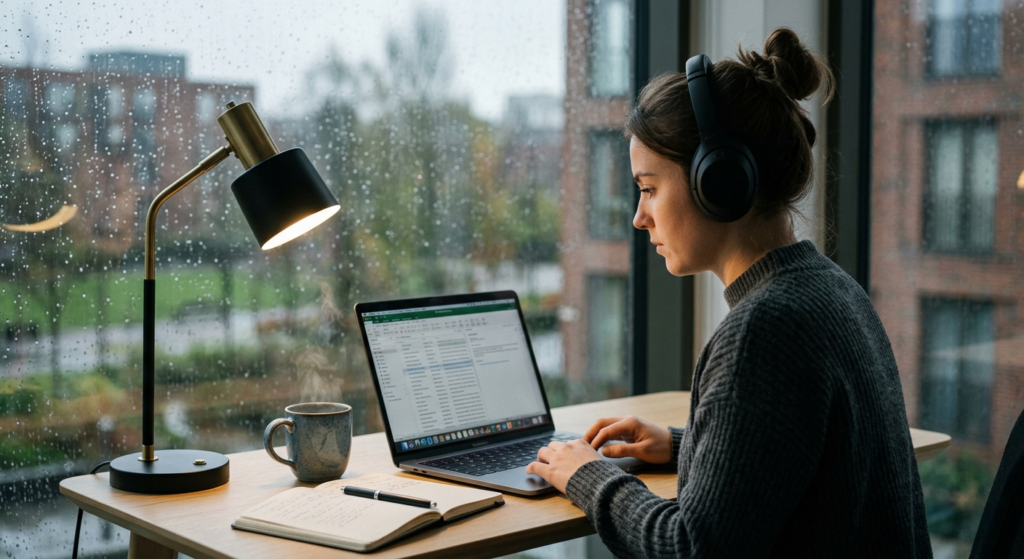
Out of frustration I opened a rain sounds video on YouTube. I put my headphones on mostly to block out the neighbor. And within about ten minutes something shifted. My thinking got smoother. The words started coming. I worked for ninety minutes without looking up once.
That was the day I started taking ambient sound for focus seriously.
Why Silence Is Not Actually the Answer
Most people assume silence is the gold standard for concentration. We have been told this our whole lives. Quiet library. Quiet study room. Quiet office. The quieter the better.
But here is what actually happens in a perfectly silent room.
Your brain never truly switches off its listening system. This goes back thousands of years. When early humans sat in a quiet forest, any sudden sound meant something was wrong. A snapping branch. A rustle in the bushes. Your survival depended on noticing those sounds immediately.
That system is still running in your head right now. In a silent room your brain stays alert, constantly scanning the environment for anything that breaks the quiet. And when something does break it, even something completely harmless like a car passing outside, you get a small but real alert response. Your attention jumps. Your focus breaks. You have to rebuild it from scratch.
This is why so many people find it almost impossible to concentrate in total silence. It is not a personal failing. It is your ancient brain doing exactly what it evolved to do.
What Ambient Sound Actually Does to Your Brain
When you introduce a steady background sound, something called acoustic masking happens.
The ambient sound raises the baseline noise level in your environment. Because the background is already filled with a consistent soft hum or the sound of rain, sudden noises get absorbed into it. Your brain does not register the sharp contrast. The alert system does not fire. Your focus stays intact.
According to research highlighted by the American Psychological Association, our attention systems are particularly sensitive to sudden environmental changes. Acoustic masking addresses this directly. It smooths out the audio landscape around you so your brain stops hunting for threats and starts doing actual work.
There is also something worth noting about what steady background sound does to your mental state more broadly. The right ambient sound for focus does not just block distractions. It creates a kind of psychological container. A signal to your brain that this is a work environment. Over time your mind starts to associate that specific sound with concentration, and entering focus gets faster and easier every time you use it.
The Science of How Sound and Attention Work Together
Your auditory system and your attention system are more connected than most people realize.
When you are in silence, your brain splits its resources. Part of it is on the task in front of you. Another part is monitoring the environment for sound changes. That split attention costs you even when nothing actually interrupts you. The vigilance itself is draining.
Ambient sound for focus essentially gives that monitoring system something steady to sit with. It does not have to work as hard to detect changes because the baseline is already rich with consistent sound. That freed-up cognitive bandwidth goes back to the task.
Researchers have also found that moderate levels of ambient noise, around 65 to 70 decibels, the rough equivalent of a coffee shop, can actually enhance creative thinking compared to both silence and loud noise. This is sometimes called the Goldilocks zone of background sound. Not too quiet. Not too loud. Just enough to keep the brain gently engaged without overwhelming it.
The type of sound matters too. Music with lyrics engages the language processing parts of your brain, which directly competes with reading and writing tasks. Your mind tries to process the words you are hearing while also processing the words you are reading or writing. Something has to give. Usually it is your comprehension.
Wordless ambient sound sidesteps this entirely. There is nothing to decode. Nothing competing with your thinking. Just a consistent backdrop that keeps the audio environment stable while your actual brain power goes toward the work.
7 Types of Ambient Sound for Focus and When to Use Each One
Not all background sounds work the same way for all people or all tasks. Here is a breakdown of the main options and what each one does best.
1. White Noise
White noise is a flat, even sound that covers all frequencies equally. Think of a spinning fan, an air conditioner, or television static. It is excellent for blocking out loud, unpredictable environments like open offices, busy streets, or apartments with thin walls.
White noise works best when your main problem is external noise intrusion. It is not particularly pleasant to listen to for long periods but it is highly effective at masking sharp interruptions.
2. Pink Noise
Pink noise has the same frequencies as white noise but with more energy in the lower ranges, which makes it sound warmer and more natural. Steady rainfall is probably the most common example. Wind through trees is another.
Most people find pink noise significantly easier to listen to for extended periods than white noise. It is a good everyday choice for ambient sound for focus because it is both effective at masking and genuinely pleasant to work alongside.
3. Brown Noise
Brown noise goes even deeper into the low frequencies. Heavy waterfall, distant thunder, or a rumbling river. It sounds rich and full without being harsh.
Brown noise tends to work especially well for people who feel anxious or mentally scattered. The deep, consistent rumble has a calming effect that helps quiet an overactive mind before you sit down to work. If you find it hard to settle into focus because your thoughts keep racing, brown noise is worth trying first.
4. Binaural Beats
Binaural beats work differently from the other sounds on this list. When you play two slightly different frequencies, one in each ear, your brain creates a third internal frequency that bridges the gap between the two. This internal tone influences your brainwave state.
Alpha frequency binaural beats, around 8 to 12 Hz, are associated with calm, relaxed focus. Theta frequencies, around 4 to 8 Hz, are linked to deeper creativity and insight. You need headphones for binaural beats to work properly since each ear needs to receive a separate frequency.
5. Nature Sounds
Rain on a roof. Waves on a shore. A stream moving over rocks. Birdsong in a morning forest. Nature sounds work partly through acoustic masking and partly through something researchers call attention restoration theory.
Natural soundscapes allow your directed attention to rest while your broader awareness stays gently engaged with the environment. This is part of why a walk outside can feel mentally refreshing even when you are not consciously thinking about anything. Nature sounds in headphones recreate some of that effect.
6. Coffee Shop Ambient Sound
The low hum of a busy cafe, distant conversations, the sound of espresso machines and clinking cups, has become one of the most popular ambient sound for focus choices in the last decade.
There is research suggesting that the moderate level of background chatter in a coffee shop environment is close to the ideal cognitive noise level for creative tasks. It is busy enough to mask silence without being loud enough to intrude. The absence of clear conversation means your language system does not try to eavesdrop.
7. Lo-Fi Music
Lo-fi music sits in a slightly different category because it involves actual music. But the genre is specifically designed for background listening. Slow tempos. Muffled, warm production. No lyrics or minimal melodic variation. It creates an atmospheric texture rather than a song that demands attention.
Many people use lo-fi for ambient sound for focus during lighter tasks, reading, organizing, email, where the brain does not need to do its heaviest lifting. For deep writing or complex problem-solving, the purely non-musical options tend to work better.
How to Use Ambient Sound for Focus Properly
Having the right sound is only half of it. How you use it matters just as much.
Volume is critical. Your background sound should sit comfortably behind your thoughts, not compete with them. A rough guide is that you should be able to speak at normal volume and hear yourself clearly over the sound. If you would have to raise your voice, it is too loud. Experts at Harvard Health consistently recommend keeping listening volumes at safe levels, especially for extended sessions. Protecting your hearing is not optional if you plan to use this habit for years.
Use it alongside a time structure. Ambient sound on its own helps but it works significantly better when paired with a focused work system. The most effective combination is a steady background sound alongside timed focus sessions. Open the Pomodoro Focus Timer and commit to twenty-five minutes of single-task focus while your chosen sound plays. The timer gives your session a clear start and end. The sound gives your environment a protective layer. Together they create conditions where deep work becomes much easier to access.
Match the sound to what you are doing. Heavy cognitive tasks like writing, analysis, or coding generally work better with simpler sounds like rain or brown noise. Lighter tasks like organizing, responding to messages, or doing routine admin can tolerate more variety. Paying attention to what works for your specific type of work will help you build a personalized system over time.
Be consistent. The conditioning effect of ambient sound builds over time. If you always use the same sound when you sit down to focus, your brain starts to associate that sound with concentration. Eventually just putting the headphones on and pressing play creates a faster and easier transition into focus than it did when you started. Consistency is what turns a useful trick into a powerful habit.
Building a Focus Routine Around Sound
Ambient sound for focus works best as part of a broader daily routine rather than a standalone solution.
The most productive people tend to have consistent environmental triggers that signal to their brain when it is time to work. A specific desk. A specific time of day. A specific drink. A specific sound. These cues become automatic over time. You stop having to negotiate with yourself about whether to start. The environment does the convincing.
Sound is one of the easiest and most powerful of these cues to build into a routine because it is immediate and portable. You can be anywhere with headphones and recreate the same focused environment your brain has been trained to respond to.
A simple starting routine looks like this. At the same time each day, sit at your workspace, put your headphones on, open your chosen ambient sound, and start the Pomodoro Focus Timer. Do this for two weeks without changing the sound or the structure. By the end of that period the routine itself will start pulling you into focus faster than willpower ever could.
Common Mistakes People Make With Background Sound
A few things consistently undermine the benefit of ambient sound for focus even when people are trying to use it correctly.
Using music with lyrics for writing or reading tasks. Already covered this but it is the most common mistake and worth repeating. Your language processing system cannot serve two masters. Give it wordless sound and let it focus on your actual work.
Turning the volume up too high to block stress rather than distraction. When you are anxious or overwhelmed, the instinct is often to drown everything out with louder sound. But high volume does not reduce cognitive load. It adds to it. If you are stressed, brown noise at a moderate level will help more than anything blasting at maximum volume.
Switching sounds too often. Part of the benefit of ambient sound for focus is the consistency. If you are spending time every twenty minutes hunting for a different playlist or trying a new sound, you are interrupting the very state you are trying to protect. Pick one sound for a full session and stick with it.
Treating it as a magic fix without changing anything else. Ambient sound helps significantly but it does not compensate for an unclear task, a phone sitting face-up on the desk, or a browser with seventeen open tabs. It works best when the other basics are in place.
Frequently Asked Questions
Does ambient sound actually improve concentration or is it just a preference?
There is real research behind it. Acoustic masking is a documented phenomenon. The effect of moderate ambient noise on creative cognitive tasks has been studied and the results consistently show benefit over silence for most people. That said, individual differences exist. Some people genuinely focus better in quiet. The best approach is to experiment with different types of sound and measure your own output honestly.
Can I use music instead of ambient sound for focus?
For some tasks yes, for others no. Music without lyrics works similarly to ambient sound and can be effective for tasks that do not involve heavy language processing. Music with lyrics consistently interferes with reading and writing tasks. If your work involves words, stick with wordless sound.
How loud should my ambient sound be?
A good rule of thumb is the conversation test. If you can hear yourself speak at normal volume over the sound, it is at a safe level. Anything louder than that for extended periods risks causing fatigue and long-term hearing issues. Moderate and consistent beats loud and varied every time.
What is the best ambient sound for someone with ADHD?
Brown noise and pink noise tend to work particularly well for people who find their attention hard to settle. The deeper frequencies seem to have a calming effect that helps reduce the mental restlessness that makes focus difficult. Binaural beats in the alpha range are also worth experimenting with. Everyone responds differently so testing a few options over several days will give you a clearer picture than any single session.
How long does it take to see results from using ambient sound?
Many people notice a difference in their first session. The acoustic masking effect is immediate. The deeper conditioning effect, where the sound itself starts triggering focus automatically, builds over two to four weeks of consistent use.
Final Thoughts
Silence sounds like the obvious answer when you want to concentrate. But for most people, in most environments, it creates as many problems as it solves.
The right ambient sound for focus does not fight your brain’s natural instincts. It works with them. It gives the monitoring system something stable to rest on. It conditions your mind to associate a specific environment with deep work. It makes the transition into focus faster and less effortful over time.
You do not need special equipment or a perfectly quiet home office. You need headphones, a good sound source, and a consistent habit.
Start simple. Pick one sound from the list above. Open the Pomodoro Focus Timer and commit to one twenty-five minute session with that sound playing at a comfortable volume. Do not change anything else. Just work.
Notice what happens to your focus compared to how your usual sessions feel.
That difference is ambient sound for focus doing exactly what the science says it should.
